Introduction
For a long time, the practical limit of my deep-sky setup was not the telescope or the camera. It was tracking. The Sky-Watcher Evostar 72ED DS Pro, with its 72 mm aperture and 420 mm focal length, was already giving the Nikon D3400 a useful field of view. The Explore Scientific iEXOS-100 PMC-Eight mount could follow the sky, but without a separate guiding system I had to keep individual exposures short.
Adding guiding did not turn the setup into a different instrument. The telescope, Nikon and mount remained the core of it. What changed was the amount of time I could keep the shutter open while the stars stayed controlled. Moving from roughly 20–30 seconds to stable exposures of 120 and 180 seconds changed both the data in a single frame and the way I could plan an entire night.
Before guiding
Before the guide camera was running, exposures around 20 to 30 seconds were typical. I often worked at ISO 800–1600 to record enough signal with the Nikon D3400 during those short frames. This approach was useful: it let me learn the mount, framing and the basic capture workflow without adding another optical system and another software loop.
The limit became clearer on faint deep-sky targets. Short frames can be stacked, but each begins with only the signal gathered in those few seconds, and a long session creates many files. The mount tracked, but did not yet correct small errors during an exposure.
Building the guiding setup
The guiding system added two components: a ZWO ASI120MM guide camera and a SVBONY SV165 guide scope with a 30 mm aperture and 120 mm focal length. The small guide scope watches a star independently from the main Evostar, while the ASI120MM sends a continuous view to the guiding software.
PHD2, used through the Ekos environment, measures the guide star’s movement and sends corrections to the mount. The Nikon D3400 remains the imaging camera; the guide camera does not create the final photograph. Its job is to provide feedback while the main camera is collecting light. Getting that chain to work reliably was more important than chasing an impressive number on a graph.
The first long exposures
Once guiding was operating consistently, 120-second frames became realistic, followed by 180-second exposures. The difference was immediately practical: instead of ending a frame after half a minute, the setup could continue collecting light for three minutes. For these longer exposures I could work in a lower range, including ISO 400–800, depending on the session.
The important part was repeatability. A single long frame is not a complete result; I needed to repeat it throughout a sequence. That made 180 seconds a working capture length rather than an occasional experiment.
What actually changed
The largest change was the amount of signal available in one exposure. A 180-second frame gathers light for six times as long as a 30-second frame. That does not remove the need for stacking, careful processing or enough total integration time, but it gives each individual frame a much deeper starting point.
Guiding also changed the scale of a session. Repeatable long exposures made larger deep-sky datasets practical without relying only on hundreds of short frames. I still had to check the sequence and mount, but more of the night could be spent gathering light from the target.
M8 and M20 as a practical test
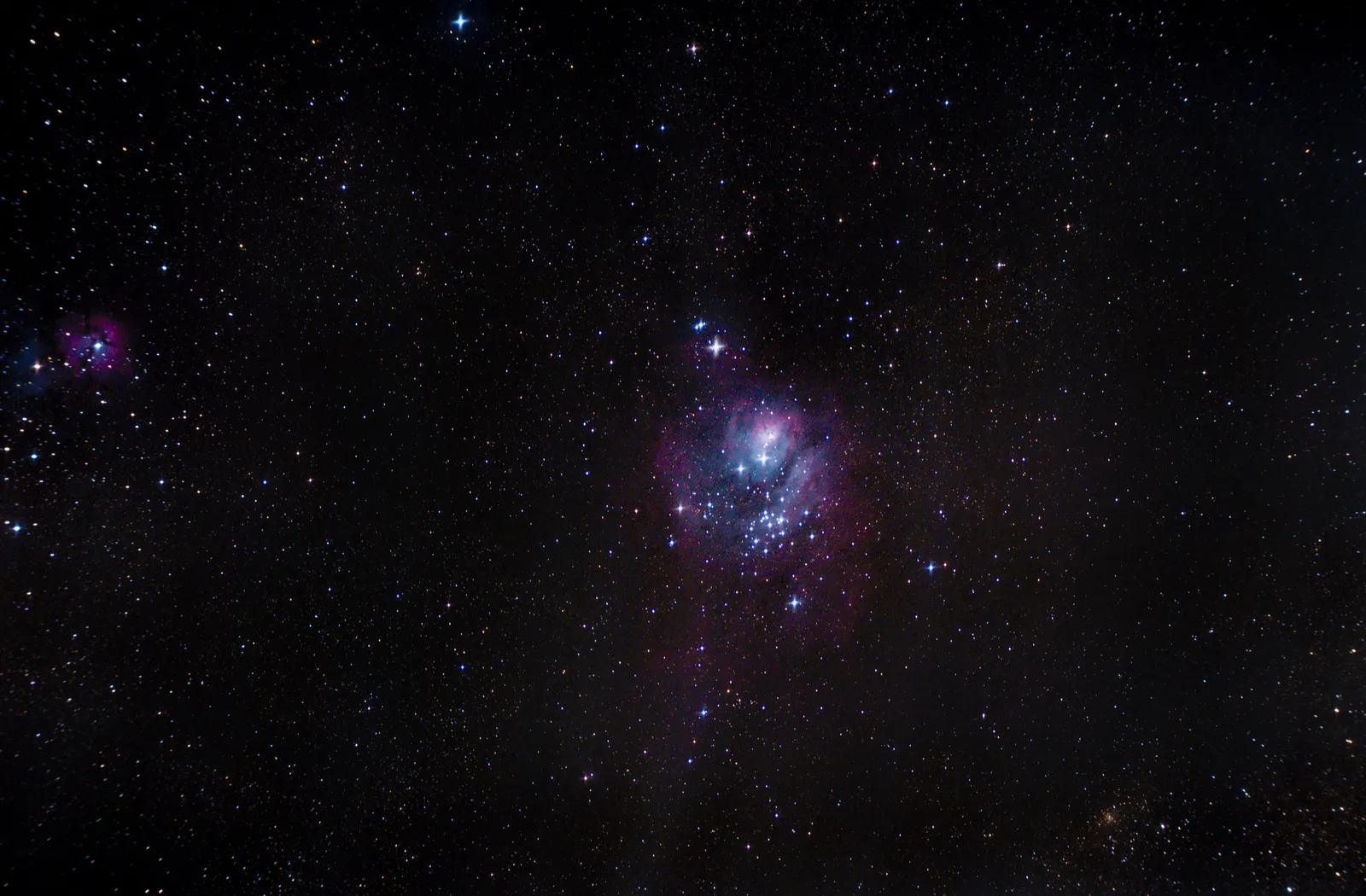
The field containing M8, the Lagoon Nebula, and M20, the Trifid Nebula, became a practical test of this setup. The Evostar and Nikon frame both nebulae together against the rich Sagittarius star field. One part of the session contained about 40 frames at 180 seconds and ISO 400.
That sequence represented roughly two hours of long-exposure data. More importantly, it showed that the full chain could work together: the iEXOS-100 carried the imaging setup, the ASI120MM and SV165 monitored a guide star, PHD2 and Ekos handled corrections, and the Nikon recorded the main frames. The photograph is therefore tied directly to the technical change described here, not just used as a decorative example.
What guiding does not fix
Guiding does not replace correct mount setup or polar alignment. If the mount is poorly prepared, the guiding system has to fight a problem that should have been reduced before capture began. It can correct tracking during an exposure, but it cannot make every underlying setup error disappear.
It also does not guarantee that every frame will be useful. The lesson was to treat guiding as one part of the imaging system, alongside mechanical setup, polar alignment, capture settings and later stacking. I do not need an unverified RMS value to know whether the change mattered; the repeatable 120- and 180-second frames provide the practical evidence.
Next steps
The next step is consistency rather than simply making the exposure time longer. Stable 180-second frames already open the door to deeper sessions with the current telescope and camera. The useful goal now is to repeat that performance across more nights and targets, while continuing to improve the setup work that guiding depends on.
Going from 30 to 180 seconds was not a shortcut around the fundamentals. It was the point at which the individual parts of the Recon setup began working as a feedback-controlled system. That made each exposure more productive and made longer deep-sky projects realistically achievable.