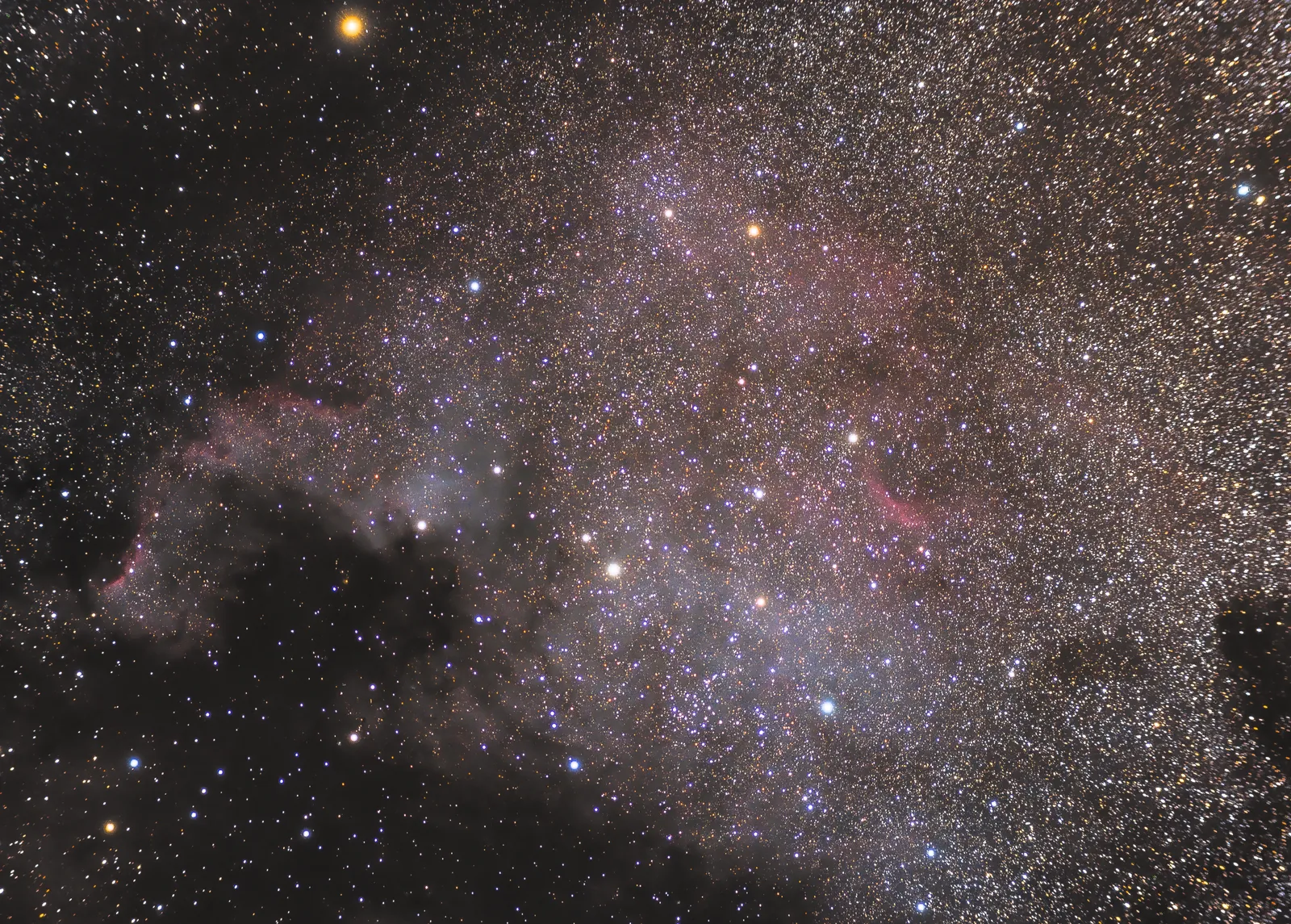
A nebula hidden in a field of stars
At first glance, this part of the night sky looks like an enormous field filled with stars. A camera, however, can collect light for much longer than the human eye. After several minutes of exposure, faint structures begin to appear: glowing clouds of gas crossed by dark regions of interstellar dust.
NGC 7000 is known as the North America Nebula because its shape resembles the North American continent. It lies in the constellation Cygnus, in one of the richest star fields of the Milky Way.
The reddish and pink areas visible in the photograph are mainly produced by glowing hydrogen gas. The dark structures are not empty regions of space. They are clouds of dust that block some of the light coming from behind them.
Why use long exposures?
Objects such as NGC 7000 are extremely faint compared with everyday objects we photograph.
A normal photograph captures light for a fraction of a second. In astrophotography, a single exposure can last several minutes.
For this image I used 15 exposures of 180 seconds each at ISO 400. This means the camera collected a total of 45 minutes of light.
Instead of taking one extremely long photograph, astrophotographers usually take many separate exposures and combine them later. This technique is called stacking.
What is stacking?
Every photograph contains both useful information and unwanted noise.
When many photographs of the same object are precisely aligned and combined, the real astronomical signal becomes stronger while random noise becomes less visible.
A simple comparison would be trying to hear a quiet voice in a noisy room. Listening for only a moment may not be enough. If you listen for longer, the voice becomes easier to distinguish from the background noise.
Stacking works in a similar way with light.
Why do the stars stay sharp?
The Earth is constantly rotating.
If the camera remained completely stationary during a three-minute exposure, the stars would appear as small trails instead of points.
The telescope is therefore mounted on a motorized astronomical mount that slowly follows the apparent movement of the sky.
For this session I also used guiding.
A small guide telescope and a second camera constantly watch one selected star. If that star begins to move slightly away from its expected position, the system sends a correction to the mount.
This makes it possible to take long exposures while keeping the stars as sharp as possible.
What are dark frames?
The camera itself also produces noise.
To help remove some of it, I captured dark calibration frames. A dark frame is taken using the same exposure settings as the normal photographs, but with the telescope completely covered.
Because no light can reach the sensor, the frame records mainly noise and sensor-related artifacts.
These frames can then be used during processing to reduce unwanted patterns in the final image.
From individual frames to the final image
The photographs were processed mainly in Siril.
First, the calibration frames were prepared. The individual photographs of NGC 7000 were then calibrated and aligned using the stars as reference points.
After alignment, all 15 exposures were stacked into one image.
The resulting image still does not immediately look like the finished photograph. Much of the faint information is hidden in the darker part of the image.
The next step is to carefully stretch the image, correct the background and bring out the weak signal of the nebula without destroying the stars or introducing excessive noise.
Final adjustments were made in Adobe Lightroom.
What are we actually looking at?
The most important thing to understand is that the processing does not create the nebula.
The structures are already present in the original data.
Image processing simply makes extremely faint differences in brightness and colour easier for us to see.
NGC 7000 is surrounded by an enormous number of stars because we are looking through a very rich region of the Milky Way. Between those stars are vast clouds of gas and dust.
Some of that gas emits light. Some of the dust blocks it.
Together they create the complex structures visible in the photograph.
45 minutes of collected light
The finished image can be viewed in just a few seconds, but creating it requires much more than pressing the shutter button.
The telescope must be set up and aligned, the target must be found, guiding must be started and the camera must remain pointed at exactly the same part of the sky while the exposures are collected.
For this photograph, the final stack contains 45 minutes of light.
And that is one of the most fascinating things about astrophotography: these structures are above us all the time. We simply need the right equipment, enough time and enough collected light to reveal them.