Imagine a world without a watch, a phone, GPS or a weather forecast.
There is no app telling you that winter begins in three weeks. No calendar hangs on the wall. No map leads you home. Even telling the time after sunset is not as obvious as it is today.
And yet, above your head, a mechanism repeats its movements day after day and year after year.
The Sun rises and sets. The Moon changes phase. Some stars appear at particular times of the year while others disappear. The points where the Sun rises and sets slowly move along the horizon, only to reverse direction months later.
To someone living several thousand years ago, these were not simply beautiful sights.
The sky was the greatest clock nature had ever built.
Before we asked what stars are
Modern astronomy asks about the distances to galaxies, the chemical composition of stars and the origin of the Universe.
The earliest skywatchers faced much more immediate problems.
When was the right time to sow crops? How long would the night last? Which direction were we travelling? When would a particular season return?
You did not need to know what a star was to answer some of these questions. You only had to notice that the sky did not change randomly.
Repetition was the key.
In the agricultural societies of the ancient world, astronomical events could serve as markers of the seasons. Around the Mediterranean, the appearances and disappearances of particular stars and constellations became associated with agricultural work and seasonal weather.
There was no need to understand orbital mechanics.
You only had to remember:
“When this happens in the sky, that usually follows on Earth.”
There is something remarkably important hidden inside that simple connection.
It is not yet physics.
But it is already the beginning of observational astronomy.
The world’s largest calendar
One of the most obvious cycles is the day.
The Sun moves across the sky, shadows change their direction and length, and after sunset another regular spectacle begins — the movement of the stars.
Then come the longer cycles.
The phases of the Moon.
Changes in the length of the day.
The changing position of sunrise along the horizon.
The return of particular stars.
The seasons.
In ancient Egypt, the measurement of time and the calendar were closely connected with the sky. The night was divided in part by observing groups of stars known today as decans. The heliacal rising of Sirius was also particularly important: its reappearance in the morning sky was associated with the beginning of the year and occurred close to the period of the annual Nile flood.
That does not mean the star caused the river to flood.
It means something more interesting.
The sky could reveal where people were within an earthly cycle.
We essentially do the same thing today, except that our calendar has been converted into numbers, servers and electronics. Looking at the date on a phone, we no longer need to spend months watching where the Sun rises.
When stone begins to mark time
Stonehenge today is covered in almost as many myths as the internet has theories about pyramids.
Fortunately, we do not need to invent anything to make it interesting.
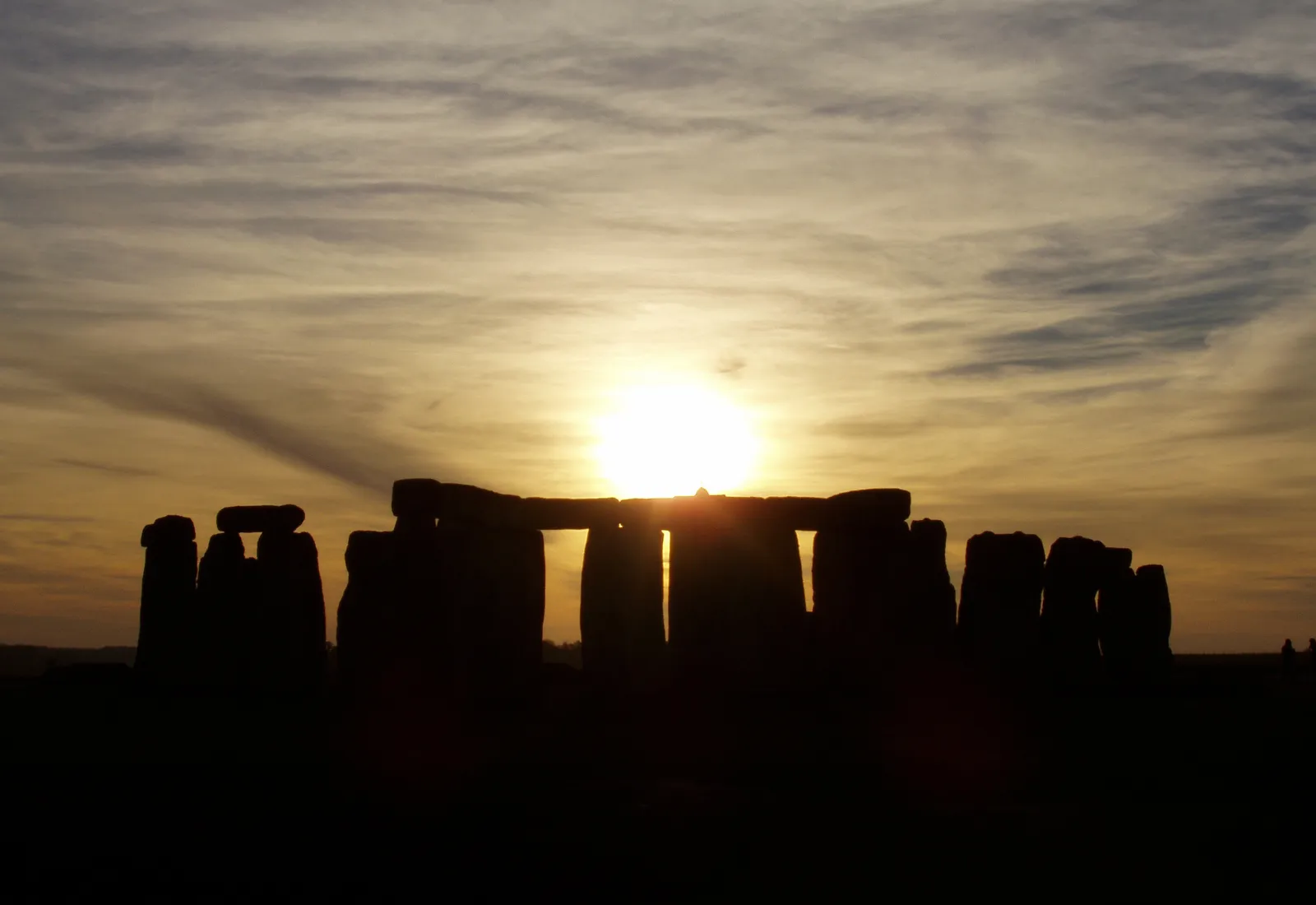
The monument really is connected with the position of the Sun at the solstices. Its principal axis corresponds to the direction of the midsummer sunrise and the midwinter sunset. Stones associated with this axis were also worked with particular care.
We do not know everything about what the site meant to the people who built it.
That distinction matters.
Stonehenge does not need to be called a “prehistoric computer” or an observatory in the modern sense to tell us something extraordinary.
Its builders understood the annual cycle of the Sun well enough to incorporate it into a monumental structure.
First, they had to observe.
Then notice repetition.
Then remember where on the horizon the Sun appeared.
And finally use that knowledge in a structure that survived for thousands of years.
That is no longer a casual glance at the sky.
It is knowledge being passed between generations.
The sky was also a map
On land you can remember a river, a hill or a distinctive tree.
On the open ocean, things become more difficult.
There is only water and the horizon.
But the sky is still there.
The rising and setting positions of stars can provide directions. The Sun can guide during the day, stars during the night, and an experienced navigator can combine them with wind, ocean swells and other signs in the environment.
Traditional Polynesian navigation demonstrates just how far such knowledge can be developed without a magnetic compass or GPS. Navigators used the Sun, stars, swell directions, clouds and the behaviour of birds, while the rising and setting positions of stars formed a kind of celestial compass.
The sky was therefore not a map in the same sense as the map on a phone.
It did not say, “turn left in 300 metres.”
It provided something more fundamental:
direction.
And once you know direction and can observe change for long enough, you can begin to build a system.
The most important discovery had no single author
We do not know who first noticed that the position of stars could help identify a season.
That is probably appropriate.
This story does not need a lone genius.
Early astronomy was built by generations of people passing observations from one to another. Someone noticed a pattern. Someone remembered it. Someone checked it again. Someone taught the next generation.
Eventually, however, memory was no longer enough.
If you only want to notice that a particular star returns to the morning sky each year, experience may be sufficient.
But if you want to answer a harder question —
exactly when will it return?
— you must begin comparing observations.
And to compare observations, you need to record them.
Something happened here that would become fundamental to the history of astronomy.
Humans stopped merely looking at the sky.
They began producing data.
From watching to measuring
This is where astronomy begins to look like something we would recognise today.
Not because the telescope had appeared.
That was still thousands of years away.
Not because anyone understood gravity.
Newton was nowhere on the horizon.
The breakthrough came earlier.
Once observations could be recorded and compared, the sky was no longer only a collection of signs, stories and symbols.
It became something that could be measured.
Among the people who developed this art to an extraordinary level were the inhabitants of Mesopotamia.
On clay tablets they began leaving behind something that sounds surprisingly familiar to a modern astronomer:
series of observations.
And that is where the next chapter begins.
Next: “Babylonian Records of the Sky — When Observation Becomes Data.”
Sources
The Metropolitan Museum of Art — Telling Time in Ancient Egypt
English Heritage — Understanding Stonehenge
University of Cambridge — Astronomy and Weather Prediction
Smithsonian National Air and Space Museum — Navigation and Astronomy: Hokule’a Style
Image credit
Hero image: Jeffrey Pfau (Oni Lukos), Stonehenge cloudy sunset, Wikimedia Commons — CC BY-SA 3.0. Image optimized for web publication.
