Everything you see suggests that Earth is standing still.
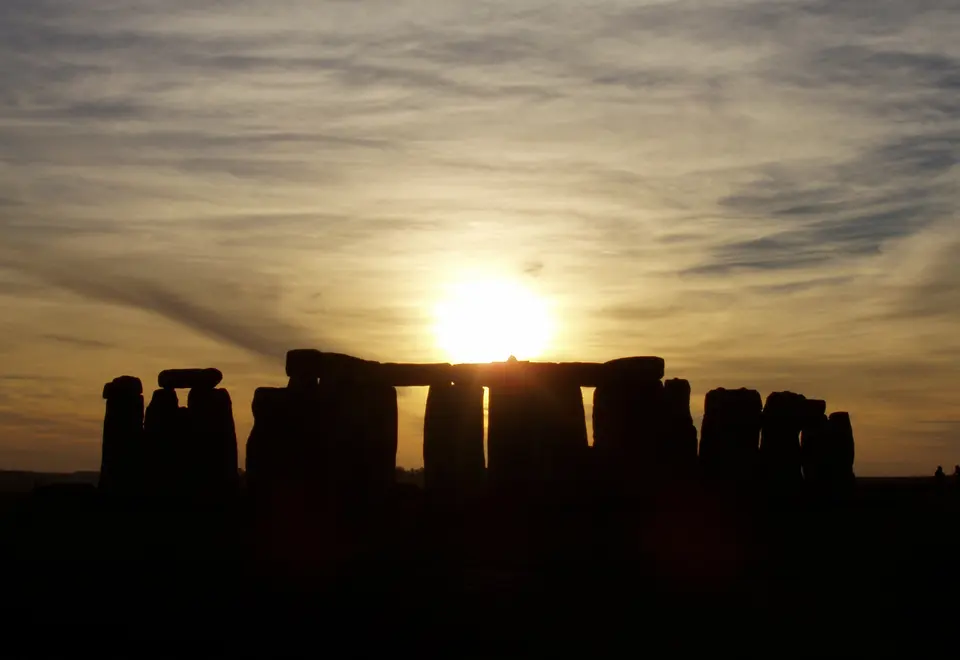
You feel no motion beneath your feet. The Sun rises, crosses the sky and sets. The Moon and stars appear to do much the same.
The most natural conclusion seems obvious:
Earth is not moving. The sky is moving around Earth.
And yet, in the third century BC, Aristarchus of Samos proposed something completely different.
Earth moves around the Sun.
Almost eighteen centuries before Copernicus.
From prediction to asking “why?”
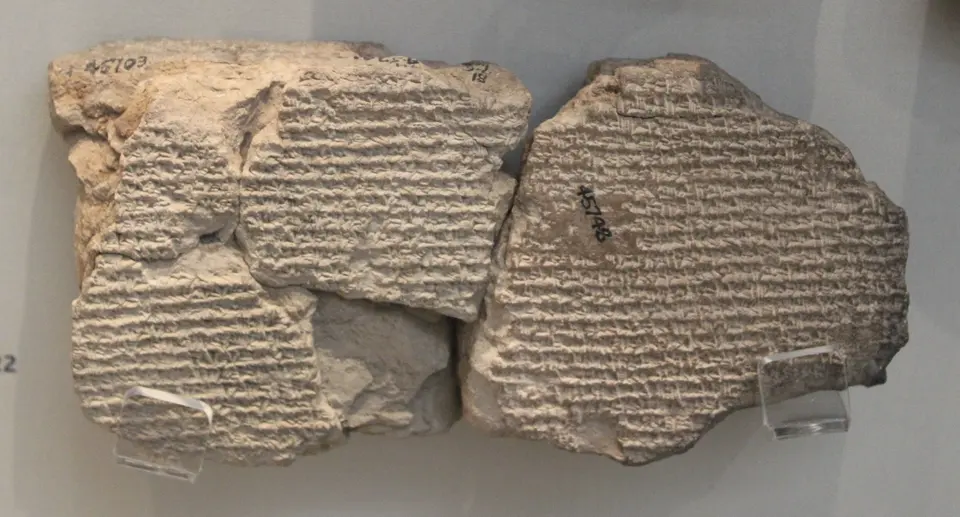
Babylonian observers had learned to record the positions of planets, recognise cycles and predict future events.
But it is possible to predict the behaviour of a system very well and still not understand how that system is actually arranged.
Greek astronomers increasingly combined observation with geometry. It was no longer enough to know where an object would appear in the sky.
A new question emerged:
what is actually moving?
This is where Aristarchus enters the story.
The man whose most important work was lost
Aristarchus came from the island of Samos and lived approximately between 310 and 230 BC.
We know about his heliocentric model mainly through later authors because the work in which he described it has not survived.
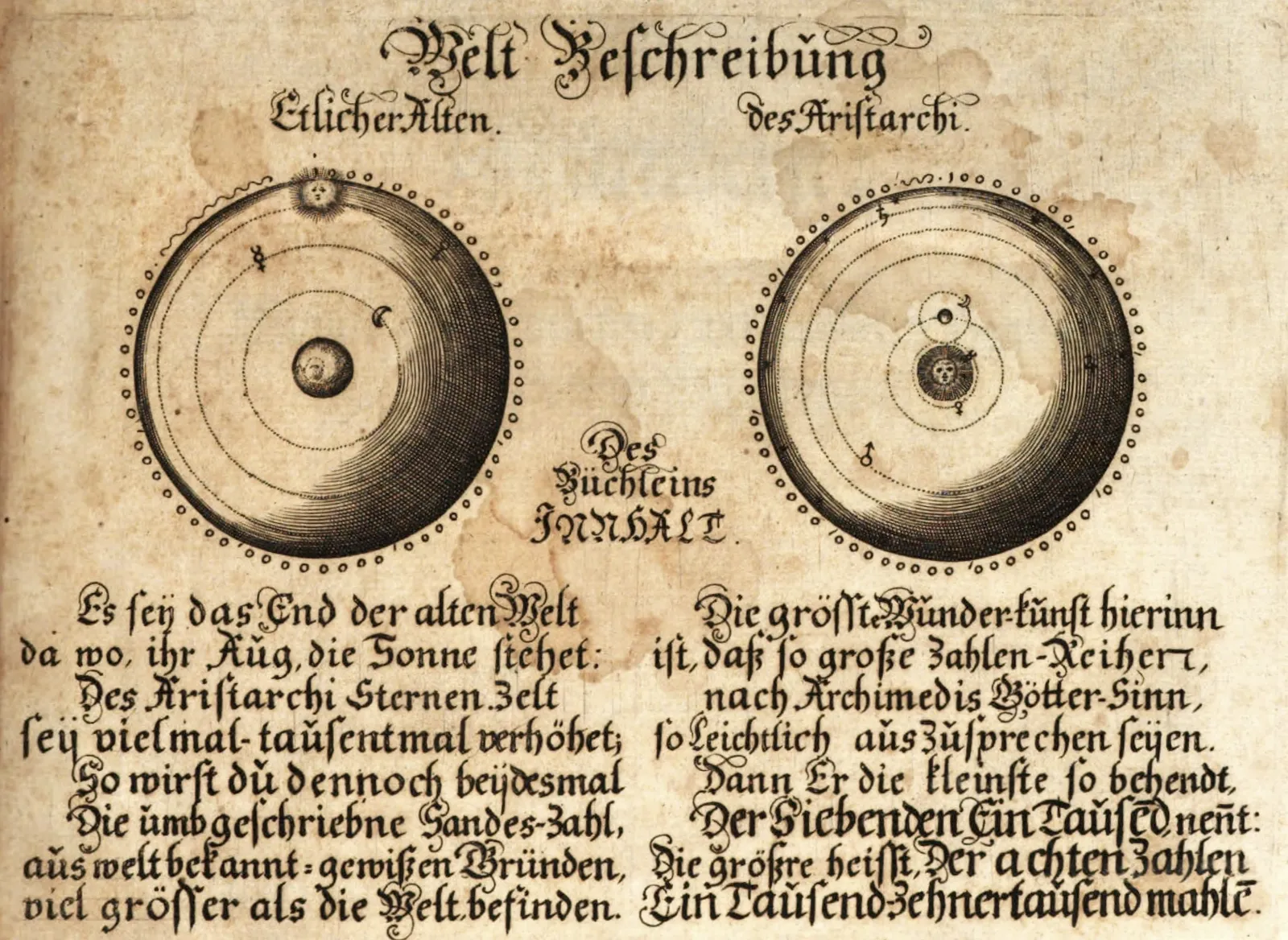
The most important testimony comes from Archimedes. He wrote that, according to Aristarchus, the Sun and fixed stars remained stationary while Earth moved around the Sun.
Later sources also report that Aristarchus accepted the rotation of Earth around its own axis.
That is enough to establish one important fact:
heliocentrism did not begin with Copernicus.
Measuring the cosmos with a triangle
Another work by Aristarchus did survive: On the Sizes and Distances of the Sun and Moon.
It reveals the way he thought.
Aristarchus attempted to determine how far away the Sun was compared with the Moon.
When we see the Moon exactly half illuminated, the Earth–Moon–Sun system forms a characteristic triangle.
If the angle between the Sun and Moon is measured from Earth, geometry can be used to compare their distances.
No journey into space is required.
No distances in kilometres are required.
Geometry is enough.
A brilliant method, but an inadequate measurement
Aristarchus assumed that, at half Moon, the angle between the Moon and Sun was about 87 degrees.
From this he calculated that the Sun was roughly 18–20 times farther from Earth than the Moon.
Today we know the real ratio is about 390.
The error was enormous, but the method itself was sound.
The problem was that the actual angle is extremely close to 90 degrees, while determining the exact moment of a perfectly half-lit Moon with the naked eye is extraordinarily difficult. A small angular error produces a huge error in the result.
It is a perfect example of an idea that was ahead of the measuring capabilities of its time.
The Sun turned out to be enormous
Even the incorrect numbers led Aristarchus to an important conclusion.
The Sun had to be much farther away than the Moon.
And because both objects appear to have a similar size in the sky, the more distant Sun also had to be much larger.
Was this the reason Aristarchus placed it at the centre of his model?
We do not know.
His heliocentric work was lost, so the full chain of reasoning has not survived.
What we do know is that a man attempting to estimate the real scale of the cosmos later proposed a model in which Earth no longer occupied the central position.
Why did nobody see Earth moving?
Heliocentrism faced a serious problem.
If Earth moves, something should reveal that motion.
The most important candidate was stellar parallax.
Hold a finger in front of you and look at it first with one eye and then the other.
Your finger shifts against the background.
If Earth occupies opposite sides of its orbit six months apart, nearby stars should also shift slightly relative to more distant stars.
Ancient observers saw no such effect.
Aristarchus had an answer:
the stars are simply unimaginably far away.
So far away that the size of Earth’s orbit becomes almost insignificant compared with their distance.
On this point, he was right.
The problem was that this could not be confirmed until many centuries later. The first reliable measurement of stellar parallax came only in the nineteenth century.
Being right is not enough
This is where the story of Aristarchus becomes especially interesting.
It is easy to tell it as the story of a genius whom the world refused to listen to.
But that would be too simple.
Aristarchus’ heliocentrism required people to accept that Earth moved despite the lack of directly visible evidence of that movement, and that the stars were at almost unimaginable distances.
Models with a stationary Earth, meanwhile, matched everyday experience and could be developed mathematically.
Aristarchus therefore had a remarkably accurate idea, but he did not possess an observation powerful enough to force other astronomers to accept it.
In science, the correct answer still has to defeat its competitors with evidence.
The idea did not disappear completely
Aristarchus’ heliocentrism did not become the dominant model, but neither was it completely forgotten.
Ancient authors preserved knowledge of his proposal, and at least one later supporter of Earth’s motion is known: Seleucus of Seleucia.
There was, however, no continuous heliocentric tradition leading directly into the Renaissance.
So we cannot simply say:
“Aristarchus invented it and Copernicus later copied it.”
There is no evidence that Copernicus’ system was a direct development of Aristarchus’ lost model.
They share the same fundamental idea.
They are separated by almost eighteen centuries of mathematical and astronomical development.
The most important change was not even the Sun
The most interesting lesson from Aristarchus is broader than heliocentrism itself.
What we see does not necessarily have to be what is actually happening.
The Sun looks as though it moves around Earth.
Earth appears to be stationary.
But we observe the Universe from a particular location.
We are part of the system we are trying to describe.
That is one of the fundamental problems of astronomy.
We do not observe the cosmos from outside.
We observe it from the surface of one of its planets.
The idea was ready. Now better measurements were needed.
The Babylonians demonstrated the power of long series of observations.
Aristarchus used geometry to try to turn the appearance of the sky into information about real sizes and distances.
His values were inaccurate, and heliocentrism failed to defeat competing models.
But the question had already been asked:
does Earth really have to be at the centre simply because the sky looks that way?
Astronomy now needed increasingly accurate measurements.
And one of the next great Greek scholars would demonstrate that even the scale of Earth itself could be measured using nothing more than a shadow and geometry.
Next: “Eratosthenes — Measuring Earth Without Satellites.”
Sources
University of St Andrews — Aristarchus of Samos
Biographical Encyclopedia of Astronomers — Aristarchus
University of St Andrews — The Structure of the Solar System
ESA Gaia — The first reliable stellar parallax
Stanford Encyclopedia of Philosophy — Nicolaus Copernicus: Notes
Image credit
Hero image: Johann Christoph Sturm, Heliozentrisches Weltbild nach Aristarchos, Wikimedia Commons — Public Domain. Image converted and optimized for web publication.